Bedding · Materials · Layering
Coyuchi Organic Cotton Bedding: How to Choose Textured Shams and Coverlets
A bed’s character rarely comes from one dramatic choice. It takes shape through quieter decisions: the surface of a sham, the weight of a coverlet, the way a pattern meets a plain sheet. With organic cotton bedding, texture can do much of the visual work—adding depth and comfort without requiring a crowded mix of color or ornament.
Published October 19, 2026
There is a useful distinction between a bed that is layered and one that is simply busy. The first has a clear rhythm: smooth against raised, patterned against quiet, a top layer that looks considered but remains easy to live with. The second often has too many competing surfaces, each asking for attention. Choosing Coyuchi organic cotton bedding is an opportunity to think about that balance—especially when selecting textured shams and coverlets.
Matelassé, dobby, and knit fabrics can each bring dimension to a bed, but they do it in different ways. A reversible design adds another practical choice. A well-placed sham can echo a coverlet’s texture or give it room to stand out. And details such as a closure, fiber certification, and washing instructions matter beyond the first impression: they help determine whether a piece suits everyday use as well as a carefully made bed.
The goal is not to follow a formula. It is to understand what a textile contributes, then make a few decisions that work together. Start with the feel you want, consider how much pattern the room can absorb, and choose a layer that fits the way the bed is actually used.
Texture is a design decision, not an afterthought
Texture changes how a bed reads before anyone examines its color or pattern. A smooth sateen catches light differently from a matte, crisp cotton. A raised weave creates small shadows across the surface. Knit stitches make a bed look more relaxed, while a tidy jacquard can give it a composed, architectural quality.
That distinction is particularly helpful when working with a restrained palette. A bed dressed in whites, natural tones, or soft color can still feel layered if its fabrics have contrasting surfaces. A plain sheet offers visual rest. A textured coverlet supplies depth. A sham adds a smaller area of pattern or relief. The result can feel complete without relying on a large number of colors.
Texture also affects how a room feels emotionally. A crisp, orderly surface may suit a more tailored bedroom; a soft knit or garment-washed cotton can suggest ease. Neither is inherently better. The most successful choice is one that suits the atmosphere you want and the practical demands of your household.
Matelassé: raised pattern with a composed look
Matelassé is valued for its dimensional surface. The woven construction creates a raised, quilted-looking pattern, but a matelassé piece is not necessarily a conventional padded quilt. Its visual interest comes from the way the fabric is constructed. The effect can be subtle—an all-over motif that becomes more noticeable as light moves across the bed—or pronounced enough to serve as the main decorative feature.
That makes matelassé a strong choice for shoppers who want a bed to feel finished without stacking on multiple bold prints. A coverlet with a textured weave can do the work of a focal layer while leaving room for simple sheets and quieter pillowcases. A matelassé sham can bring the same character closer to the head of the bed, where its detail is easy to see.
The scale of the pattern matters. A small, repeated design often reads as texture from a distance and pattern up close. A larger or more directional motif makes a stronger statement. If the bed already includes printed sheets or a patterned duvet, a tonal matelassé may help connect the pieces without introducing another competing design.
The Angeles Organic Matelasse Sham, for example, uses a braided wave pattern in 100% organic cotton, with a lightweight structure and knife-edge seams. Its surface offers definition without relying on a high-contrast print. The sham has an envelope closure and is sold individually, so it can be purchased according to the intended arrangement rather than assumed to come as a pair. Explore the Angeles Organic Matelasse Sham.
Dobby and knit: two different kinds of dimension
Dobby weaving uses a loom mechanism to create small geometric or figured patterns in the fabric. On bedding, the result may be an understated series of lines, diamonds, or other repeated details. Dobby texture tends to feel integrated into the woven surface rather than added as a separate layer. That makes it a useful option when you want detail that stays relatively quiet.
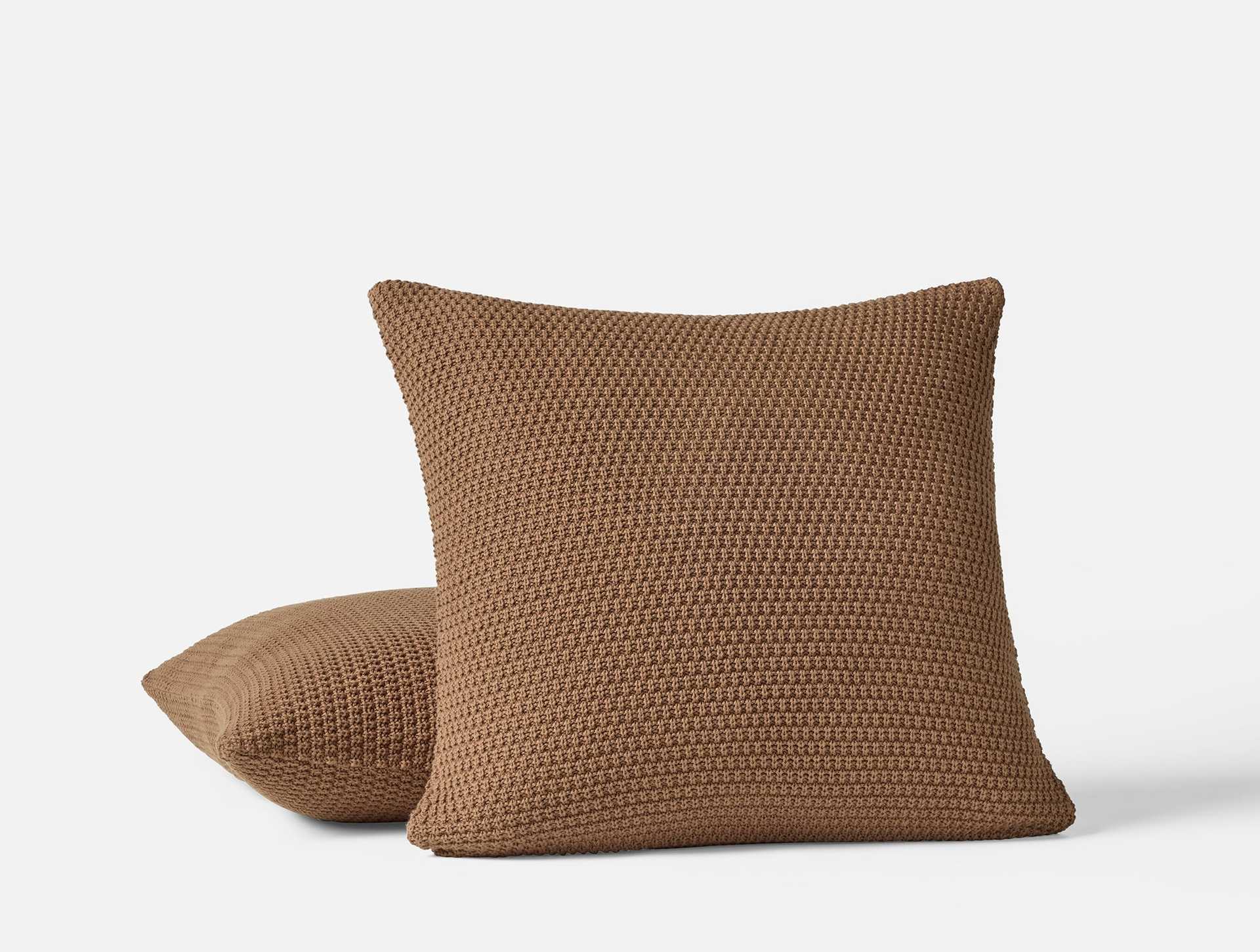
Knit fabric takes a different route. Loops of yarn form a more visibly tactile surface, often with a softer, more casual impression than a tightly woven sham. A knit cover or pillow cover can introduce warmth and a relaxed note, though it may look more at home as a decorative accent than as the principal, tightly tailored surface of the bed.
The Avalon Organic Knit Decorative Pillow Cover shows how a knit accent can add texture at a smaller scale. Made from 100% organic cotton in a brioche knit, it has an invisible zipper and is designed for a removable insert. Because it is a pillow cover rather than a sham or coverlet, it is best thought of as a finishing accent: one way to bring a softer stitch into a bedding arrangement without making the entire bed read as knit. See the Avalon Organic Knit Decorative Pillow Cover.
When combining these textures, consider contrast in both surface and visual weight. A relatively smooth sheet, a patterned dobby sham, and a chunky knit accent may create a satisfying progression. But a pronounced matelassé coverlet, several heavily textured shams, and multiple knit cushions can compete. Choose a principal texture, then let the others play supporting roles.
The coverlet sets the bed’s visual center
A coverlet sits in an influential position: it occupies a broad area, and its surface often determines whether the bed looks crisp, soft, formal, or relaxed. Before choosing one, consider what it needs to do. Is it primarily a decorative top layer? Should it provide light warmth? Will it be folded at the foot of the bed, pulled up at night, or used as the main covering in warmer weather?
These uses can point to different priorities. A lighter coverlet may be easier to fold back and layer. A more substantial surface can make the bed look grounded, but may dominate a smaller room or compete with patterned sheets. Product descriptions and construction details can help clarify intended use; they are more reliable than assuming that every coverlet has the same weight or warmth.
Reversibility offers a practical kind of flexibility. A two-sided piece may provide a pattern on one face and a solid on the other, or two related color treatments. That gives the bed a quick change of emphasis without requiring a new textile. It can also extend the usefulness of a coverlet across seasons or different styling preferences. Check how each side is finished and whether the design is equally suitable for display in both directions.
A reversible organic cotton matelassé coverlet can be especially effective when its textured surface is the primary statement. It gives the bed a defined focal plane, while the reverse offers an alternative when a quieter look is wanted. Where a coverlet is described as yarn-filled, that construction is distinct from a heavily padded comforter; look at the product’s own details rather than inferring warmth from the word “coverlet.”
Coordinate shams without making a matching set feel rigid
Shams frame the head of the bed and can either reinforce the coverlet or deliberately counterbalance it. Matching a sham to the coverlet creates continuity: the same motif or weave appears in two places, helping the arrangement feel unified. A simpler sham, by contrast, gives a richly textured coverlet more breathing room. Neither approach is compulsory. The right choice depends on how much pattern and surface variation the room can comfortably hold.
One dependable arrangement begins with a textured coverlet and plain or lightly patterned shams. Another uses solid bedding as the foundation and gives the shams a more distinctive weave. A third mixes patterns, but keeps them related through scale, color, or mood. For instance, a small woven motif can sit beside a larger floral print more comfortably when both share a restrained palette.
Think in layers of emphasis. If the coverlet is the visual anchor, let the shams support it. If the coverlet is nearly solid, shams can introduce a graphic detail. Decorative pillows can then add a smaller note of contrast, but they are not required to complete the bed. A purposeful edit often looks more considered than an accumulation of pieces.
Also confirm what the product includes. Shams are often sold individually, and decorative pillow covers may not include an insert. The Angeles sham is sold individually, while the Avalon decorative cover is sold without its insert. Checking these details before planning a pair or a full arrangement prevents a gap between the intended styling and what arrives.
Closures, edges, and the details you notice later
Construction details tend to matter most after the first styling session. An envelope closure creates a simple overlap that keeps a pillow inside the sham. A zipper can offer a different kind of access, particularly on a decorative pillow cover. Neither closure is automatically superior; what matters is whether it suits the way the item is used and how often it will be removed for laundering.
Edge finishing has a visual role, too. A knife edge gives a clean, straightforward outline. A plain hem can reinforce a tailored look, while a more decorative finish may draw attention to the pillow’s border. On a patterned or textured sham, a restrained edge often helps the surface remain the focus. On a simple fabric, a distinctive finish may be a useful detail.
Look for clear information about dimensions and intended pillow size, as well as whether the item is sold individually. A beautifully chosen sham can still disappoint if it is the wrong scale for the pillow or if its closure does not suit the insert. These practical checks are especially important when several sizes or formats appear within the same bedding collection.
What organic certification tells you—and what it does not
“Organic cotton” describes a fiber and its agricultural sourcing; a certification adds a defined standard and verification process. When a bedding item is identified as GOTS certified, the Global Organic Textile Standard is the named certification. Read the product’s own certification information to understand which piece it applies to, and avoid assuming that every item in a coordinated collection has identical materials or credentials.
Certification is one useful part of evaluating a textile, not a substitute for reading its full description. Fiber content, manufacturing location, weave, finishing, and care instructions all help explain what a product is and how it may fit into your home. For instance, organic cotton can be woven into a crisp percale, a softly textured matelassé, or a knit surface. The fiber alone does not determine the feel.
It is also worth separating a certification claim from broader assumptions. A label does not tell you, by itself, whether a fabric will feel cool, how much texture it has, or whether it can be washed in a particular way. Those questions are answered by the construction and care details for the individual product.
Care is part of choosing well
The long-term appeal of a bedding layer depends partly on whether its care routine fits real life. Some cotton shams are machine washable, but instructions can differ by weave, finish, and product. The Angeles Organic Matelasse Sham calls for a cold, gentle wash with like colors and low tumble drying, followed by prompt removal; a warm iron may be used. The Avalon Organic Knit Decorative Pillow Cover has its own instructions: machine wash cold on a gentle cycle and tumble dry low.
These differences are worth respecting. A knit and a woven matelassé do not necessarily respond the same way to heat, agitation, or time in the dryer. Check the care label before laundering, use the temperature and cycle specified, and avoid adding bleach or fabric softener unless the instructions permit it. Remove pieces promptly when advised, and iron only when appropriate for the item.
Care instructions can also influence which layer belongs where. If a coverlet or sham will be used nightly, washed regularly, or shared with children or pets, straightforward maintenance may be a deciding factor. If a piece is mainly decorative and sees less wear, a more specific routine may be manageable. The best choice is not simply the one with the most compelling surface; it is the one whose upkeep you can sustain.
A practical method for building the layers
Begin with the bed’s most constant elements: mattress size, sheets, and the duvet or blanket used most often. Note their color and surface. Then decide what the coverlet should contribute—texture, warmth, a cleaner outline, or a more noticeable pattern. This keeps the largest decorative decision connected to how the bed functions.
Next, select shams in relation to that coverlet. If its pattern is prominent, choose a quieter sham. If it is plain, a motif or contrasting weave can bring interest toward the head of the bed. Consider whether you want the surfaces to match, coordinate, or intentionally contrast. A shared color family can tie different patterns together; a clear difference in scale can prevent them from appearing to fight for attention.
- For a calm, tonal bed: pair a textured coverlet with shams in a similar color and let the weave provide the variation.
- For a more layered look: combine one patterned surface with simpler pieces, then introduce a smaller knit or woven accent.
- For a tailored arrangement: favor clean edges, a controlled palette, and a limited number of textures.
- For a relaxed arrangement: consider softer surfaces and a less formal mix, while keeping one element visually quiet.
- For everyday practicality: verify closures, included components, dimensions, and care instructions before settling on a combination.
Finally, step back and assess the bed as a whole. Does the eye know where to rest? Is the strongest texture balanced by smoother fabric? Can the layers be folded, removed, or washed without disrupting the routine? A bed should look composed, but it is not a display that must remain untouched. The most convincing arrangement is one that looks inviting and works as intended.
Choose for the hand, the eye, and the routine
Organic cotton bedding offers no single prescribed aesthetic. The same fiber can produce an airy, crisp surface or a deeply textured one; a simple sham can sit beside a patterned coverlet, while a knit accent can soften a more orderly arrangement. The deciding factors are construction, proportion, color, and care—not the assumption that everything must match.
Matelassé brings woven relief and a sense of structure. Dobby adds smaller, often quieter patterning. Knit introduces a visibly looped surface and a more relaxed note. Reversible designs create options, and thoughtful closures and edge finishes affect daily handling. Certification and fiber details help clarify how a piece is made, while care instructions show what it will ask of its owner.
Bring those considerations together and the bed becomes easier to edit. Choose one layer to lead, let the others support it, and leave enough open space for each texture to register. That is how a carefully selected sham or coverlet can make a bed feel finished without making it feel overworked.